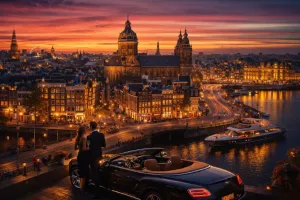
Before Zwolle grew into the provincial capital, Hasselt was already a trading town on the Zwarte Water. It received city rights in 1252, and its Hanseatic membership brought modest prosperity through river commerce. About 6,960 residents live here today, in a town that retains its medieval street plan and a few canal remnants from that earlier era.
The Grote Kerk, dating to the 15th century, dominates the small market square. A ring of green space follows the old fortification line. Hasselt's harbour, once crucial for trade with the Zuiderzee, now hosts recreational boats. The town functions as a quiet residential satellite of Zwolle, which is roughly 8 kilometres south.
Genemuiden and Zwartsluis, two other small towns along the Zwarte Water, share the waterway but developed distinct economies centred on textiles and inland shipping respectively.
Kampen lies about 12 kilometres north. The N331 connects Hasselt to the A28 motorway for access to Zwolle and beyond.
Before Zwolle grew into the provincial capital, Hasselt was already a trading town on the Zwarte Water. It received city rights in 1252, and its Hanseatic membership brought modest prosperity through river commerce. About 6,960 residents live here today, in a town that retains its medieval street plan and a few canal remnants from that earlier era.
The Grote Kerk, dating to the 15th century, dominates the small market square. A ring of green space follows the old fortification line. Hasselt's harbour, once crucial for trade with the Zuiderzee, now hosts recreational boats. The town functions as a quiet residential satellite of Zwolle, which is roughly 8 kilometres south.
Genemuiden and Zwartsluis, two other small towns along the Zwarte Water, share the waterway but developed distinct economies centred on textiles and inland shipping respectively.
Kampen lies about 12 kilometres north. The N331 connects Hasselt to the A28 motorway for access to Zwolle and beyond.
Country selected
Region selected
City selected

Drie platforms, één dominante marktpositie en circ...
Read more