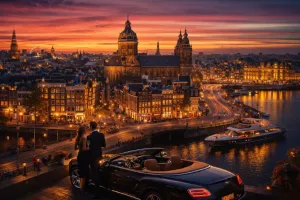
Gorinchem, locally known as Gorkum, has about 34,700 inhabitants and lies in South Holland where the Linge river meets the Waal and the Merwede. The town's 17th-century fortification walls and bastions survive almost completely, forming a star-shaped ring around the old centre that can be walked in its entirety. The Dalempoort, the only remaining city gate, dates from the 14th century.
In 1572 the Martelaren van Gorcum, nineteen Catholic clergy, were executed here during the Dutch Revolt, an event that led to their canonisation by the Catholic Church in 1867. The Grote Toren, a leaning church tower visible from the rivers, is the most recognisable structure.
Dordrecht is about 20 kilometres west. Utrecht lies roughly 40 kilometres north. The Linge, the longest river entirely within the Netherlands, meanders through the Betuwe before reaching Gorinchem.
Gorinchem, locally known as Gorkum, has about 34,700 inhabitants and lies in South Holland where the Linge river meets the Waal and the Merwede. The town's 17th-century fortification walls and bastions survive almost completely, forming a star-shaped ring around the old centre that can be walked in its entirety. The Dalempoort, the only remaining city gate, dates from the 14th century.
In 1572 the Martelaren van Gorcum, nineteen Catholic clergy, were executed here during the Dutch Revolt, an event that led to their canonisation by the Catholic Church in 1867. The Grote Toren, a leaning church tower visible from the rivers, is the most recognisable structure.
Dordrecht is about 20 kilometres west. Utrecht lies roughly 40 kilometres north. The Linge, the longest river entirely within the Netherlands, meanders through the Betuwe before reaching Gorinchem.
Country selected
Region selected
City selected
Drie platforms, één dominante marktpositie en circ...
Read more